



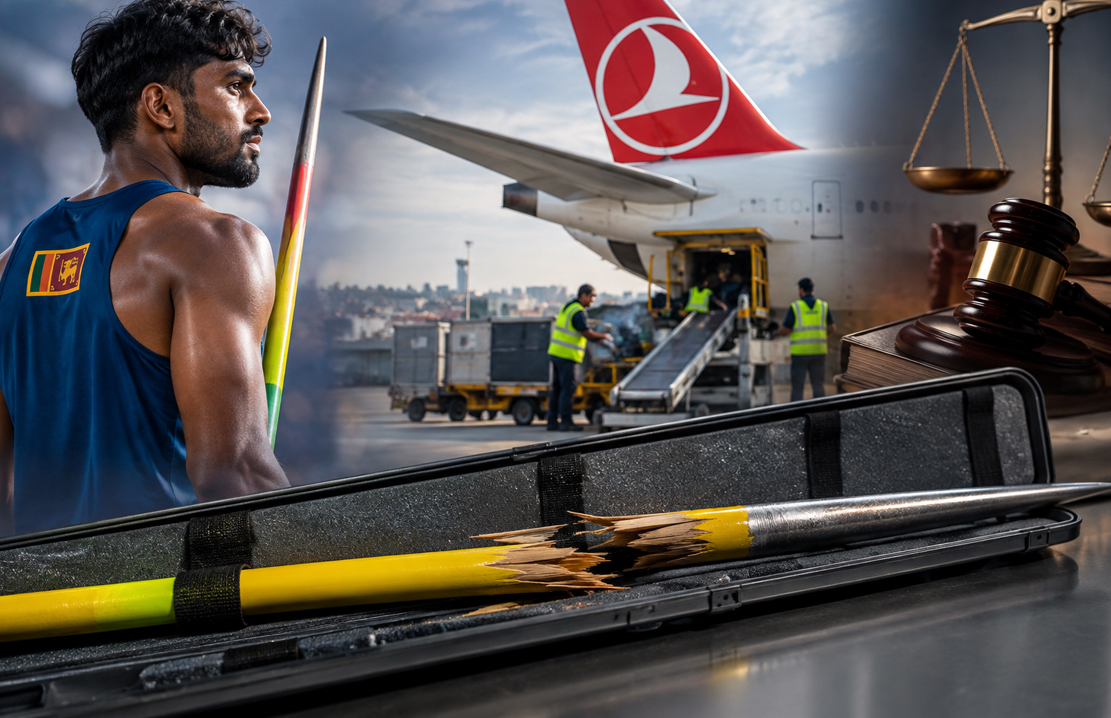
When news broke that World No. 1 javelin thrower Rumesh Tharanga’s competition javelins, including the spear used for his gold-medal-winning throw at the inaugural World Athletics Ultimate Championship in Budapest had been damaged during his flight home to Colombo, social media reaction was swift and unambiguous: Turkish Airlines was to blame, full stop. Tharanga’s father placed the value of the damaged equipment at over Rs. 2 million and a complaint has reportedly been lodged with the airline at Bandaranaike International Airport (BIA).
The public instinct is understandable. But the legal reality of who bears responsibility and to what extent is considerably more layered than a viral post allows for. This is worth unpacking properly.
The Governing Framework: The Montreal Convention
International air carriage of passengers and baggage is governed by the Convention for the Unification of Certain Rules for International Carriage by Air, signed at Montreal in 1999 (the “Montreal Convention”) to which both Sri Lanka and Türkiye are parties. Article 17(2) establishes the baseline rule: a carrier is liable for damage to checked baggage if the damage occurred while the baggage was in the carrier’s charge from check-in to delivery.
On its face, this looks like a straightforward win for Tharanga. But the same article carves out an important exception: the carrier is not liable if the damage resulted from the “inherent defect, quality or vice of the baggage.” A javelin long, rigid, and far more fragile under handling stress than an ordinary suitcase sits closer to this exception than most checked items. Whether the exception applies depends heavily on a fact social media rarely engages with: how the javelins were packaged.
The Passenger’s Obligation: Adequate Packaging
Turkish Airlines’ own sports equipment conditions require checked sporting goods to be carried in a “sturdy, protective case.” This is not an arbitrary house rule it reflects a general principle in air carriage law that the passenger bears responsibility for presenting fragile items in packaging reasonably capable of withstanding normal handling. If a javelin is handed over in an inadequate tube or case, an airline has a genuine legal argument that any resulting damage falls under the Article 17(2) exception, not the carrier’s negligence.
This is the piece of the story that a headline like “Airline Damages Athlete’s Javelins” tends to erase entirely. The question is not simply did damage occur on this airline’s watch, but was the packaging adequate, and if so, did the damage still occur through mishandling.
Declaring an Item “Fragile”: What It Does and Does Not Do
A common assumption understandable, but legally imprecise is that telling a check-in agent “this is fragile, please be careful” creates a binding obligation on the airline. It largely does not. A verbal or even a sticker-based fragile declaration is an operational signal to ground staff, not a legal instrument that shifts liability or increases the compensation ceiling.
The instrument that actually does this is Article 22(2) of the Montreal Convention: A Special Declaration of Interest. This requires the passenger to formally declare a specific value at check-in and pay a supplementary fee. Only then does the carrier’s liability ceiling rise above the standard limit (approximately 1,288 Special Drawing Rights per passenger for combined checked and unchecked baggage). Few passengers and frankly, few check-in staff use or even offer this mechanism, which means most “fragile” declarations carry more emotional weight than legal weight.
Who Actually Handles the Baggage?
A frequent point of confusion, raised often in these discussions, is that ground handling at most airports including Bandaranaike International Airport is performed not by the airline directly but by a third-party ground handling company. This does not change where liability sits from the passenger’s perspective. Under Article 17(2), the operating carrier remains liable for any damage occurring while baggage is in its charge, regardless of which contracted entity physically handled it. The contract of carriage exists between the passenger and the airline not between the passenger and the ground handler so any claim, complaint, or Property Irregularity Report is properly directed at the airline.
Where the ground handler’s negligence is the actual cause, the airline may separately pursue a recourse or indemnity claim against that handler under their IATA Standard Ground Handling Agreement. But that is an internal commercial matter between the airline and its contractor; it has no bearing on the passenger’s claim.
Insurance: Two Separate Systems
Public commentary also tends to conflate two entirely distinct insurance regimes.
First, passenger-purchased travel insurance is a private contract that may pay out for damaged sporting equipment, subject to its own sub-limits and exclusions. If a passenger recovers under such a policy, the insurer typically acquires a right of subrogation to pursue the airline separately but this does not substitute for, or negate, the airline’s own liability under the Montreal Convention.
Second, carrier liability insurance is a regulatory requirement, not a consumer product. Article 50 of the Montreal Convention obliges contracting states to ensure carriers are adequately insured to cover their own liability. Within the EU, this is codified in Regulation (EC) No 785/2004, which sets a minimum liability insurance cover of 250,000 SDRs per passenger. As a carrier operating into EU airspace and airports, and as a carrier from a Montreal Convention state, Turkish Airlines is bound by equivalent insurance obligations but this insurance is not something a passenger can claim against directly. It simply ensures the airline itself has the financial capacity to pay claims it is found liable for.
So, Is the Social Media Blame Legally Accurate
Broadly, holding Turkish Airlines responsible is not legally unreasonable Article 17(2) does place checked baggage in the carrier’s charge, and the operating carrier is answerable regardless of which handling company physically moved the equipment. Sri Lanka’s Sports Ministry pursuing a claim, and the athlete lodging a formal complaint, both follow the correct legal channel.
Where the public narrative oversimplifies is in treating liability as automatic and total. Three qualifications matter:
1️⃣ The packaging question is unresolved. If the javelins were not carried in adequately protective cases, the airline has a colourable defence under the “inherent defect” exception.
2️⃣ A “fragile” declaration alone changes little. Absent a formal Article 22 Special Declaration of Interest with a paid supplementary fee, the airline’s liability ceiling and the strength of any argument based on notice is limited.
3️⃣ Timing matters. Article 31 requires a written complaint within seven days of damage to checked baggage being discovered; a Property Irregularity Report filed promptly at the airport is what actually preserves the claim, not the volume of public commentary afterward.
In short: the instinct to point at the airline is legally defensible, but the strength of any eventual claim and the size of any compensation will turn on packaging adequacy, documentation, and whether a formal declared-value mechanism was used, not on public sentiment. That is the part a viral headline can never capture.
________________________________________
This article discusses general principles under the Montreal Convention (1999) and related aviation liability frameworks. It is not a legal opinion on the specific facts of the Tharanga case, which would require access to the actual baggage tags, packaging condition, and Property Irregularity Report filed at Bandaranaike International Airport.

