



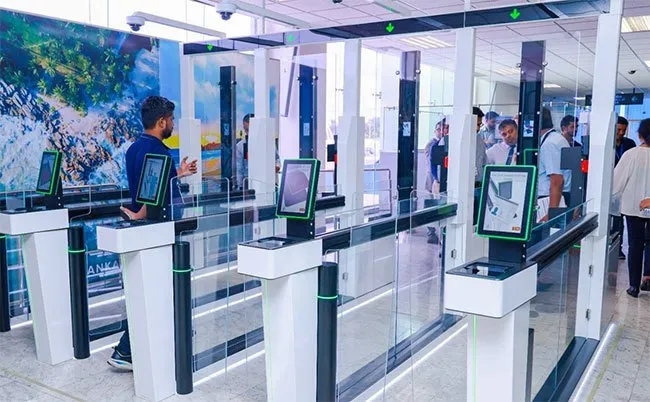
More than 23,000 travellers have used the newly installed Automated Border Control (ABC) e-gates at the Bandaranaike International Airport (BIA) since their introduction on 23 December 2025, Deputy Minister of Ports and Civil Aviation Janitha Ruwan Kodithuwakku reveals.
This, despite the much-discussed initial technical issues that had caused congestion at the terminal.
Speaking to The Sunday Morning Business, Kodithuwakku addressed recent criticism regarding delays at the ABC e-gates, which were attributed to technical difficulties, particularly in passport scanning. He explained that minor issues were expected as the system was being used in Sri Lanka for the first time.
“Considering that this system was introduced in Sri Lanka for the first time, it took us about a month to get accustomed to it. We faced some issues during practical implementation, including those related to flight information,” he said.
Kodithuwakku noted that notwithstanding these early technical setbacks, the ABC e-gate system had processed over 23,000 arriving passengers at the BIA within a month and a half of its inauguration.
He further stated that the system was expected to be highly beneficial in the long term by streamlining immigration procedures at the airport.
According to him, the e-gates have the capacity to clear a passenger in less than one minute, compared to the conventional clearance process, which typically takes three to four minutes and requires dedicated immigration officers.
Sri Lanka introduced four ABC e-gates at the BIA arrival terminal on 23 December 2025.
The project is a collaborative effort between the Ministry of Ports and Civil Aviation, Government of Japan, and International Organization for Migration (IOM).
It forms part of a Japan-funded initiative implemented by the IOM to strengthen border control capacities, particularly in response to infectious diseases in Southwest Asia.
Source: The Morning

