


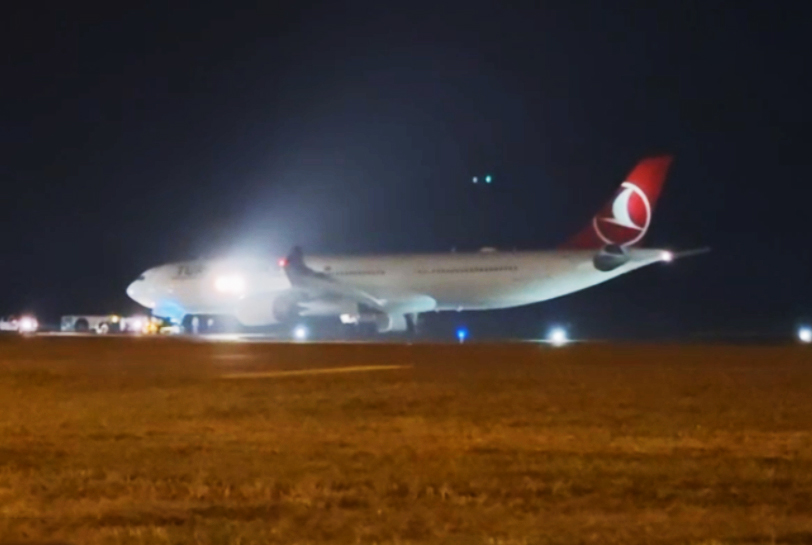
Turkish Airlines flight TK733 from Colombo to Istanbul experienced a technical issue shortly after take-off last night when the nose landing gear failed to retract into the wheel bay. Following standard aviation safety procedures, the pilots remained airborne for around two hours over the Puttalam-Chilaw area to burn fuel before making a safe return to Bandaranaike International Airport (BIA). Such fuel management, either burning or dumping is done to ensure the aircraft is within safe landing weight limits under abnormal conditions.
While the aircraft landed safely and no one was injured, it remained on the runway for a short time, delaying other flights at a busy period. Because BIA has only one runway, this meant some arrivals were diverted to Mattala Int’l Airport (MRIA) and others were placed in holding patterns.
This raises a critical question: what happens if an aircraft becomes disabled on the runway?
At single-runway airports like BIA, Katunayake, a disabled aircraft can severely disrupt operations. In such situations, the runway must be cleared as quickly and safely as possible to allow other aircraft to continue landing and departing. However, this is not simple. Commercial aircraft are large and valuable assets and improper removal can cause additional damage that may not be covered by insurance. Removing a disabled aircraft requires highly trained specialists and specialized equipment, usually through agreements with expert recovery organizations.
Many airlines participate in networks such as the International Airline Technical Pool (IATP) to ensure access to aircraft recovery services when needed. These services are provided by highly skilled teams with heavy lifting and recovery equipment capable of handling major runway incidents.
If an incident leaves an aircraft stuck on the runway, authorities typically have two options:
- Close the runway and divert or hold other flights – e.g., to alternate airports such as Mattala.
- Deploy recovery teams and equipment locally or from abroad, which can take time and carry significant costs and insurance implications.
Given the rarity of such occurrences in Sri Lanka, this incident should not be viewed as a setback, but rather as a timely reminder of infrastructure and service gaps that can be further strengthened.
Recent Regional Incidents Highlighting Runway Risks
While runway blockages due to disabled aircraft are rare, several recent incidents in Asia illustrate how runway or landing emergencies can impact airport operations:
📍 Hong Kong International Airport – Cargo Plane Runway Excursion (Oct 2025)
A Boeing 747-400 cargo aircraft, operating for Emirates SkyCargo, veered off the runway upon landing and crashed into the South China Sea, after colliding with a ground patrol vehicle. The north runway at the airport was temporarily closed while recovery and investigation were underway, illustrating the complexity of clearing a runway after an accident.
📍 Denpasar (Bali) – Aircraft Stuck on Runway (March 2025)
At Bali’s I Gusti Ngurah Rai International Airport, a commercial aircraft became stuck on the runway due to a technical fault. This forced a temporary closure of the runway for 2 hours, delaying departure and arrival flights until the aircraft was moved and inspections completed.
📍 Jeju Air Crash (South Korea, Dec 2024)
Although not strictly a runway blockage, the Jeju Air Boeing 737 accident at Muan International Airport, where the aircraft belly-landed and overran the runway after landing gear issues, underscores how severe mechanical failures involving landing gear and runway interaction can result in catastrophic outcomes.
📍 Changi Airport Emergency (2023)
An Air China flight declared an emergency landing at Singapore Changi when smoke was detected onboard, resulting in a temporary runway closure while the aircraft was towed and cleared.
This example shows how even non-collision emergencies can disrupt runway operations if an aircraft is disabled on the surface.
Why This Matters & Business Opportunity
These incidents demonstrate that runway disruptions whether due to mechanical issues, excursions or emergency landings can and do happen across the region. For Sri Lanka’s aviation sector, the Turkish Airlines TK733 event highlights both preparedness and vulnerabilities:
Safety protocols worked – the aircraft and passengers landed safely.
Operational disruption risk remains – a disabled aircraft could tie up the only runway.
Opportunity exists: investing in local specialized recovery services, training and high-tech equipment could strengthen national aviation infrastructure, create skilled jobs and attract international contracts.
Such a service would be valuable not only domestically but across South Asia and beyond, where runway incidents, though rare, have substantial economic and safety impacts. This is an aviation business segment that merits serious consideration from investors and policymakers alike.
Editor | Aviation Voice

