



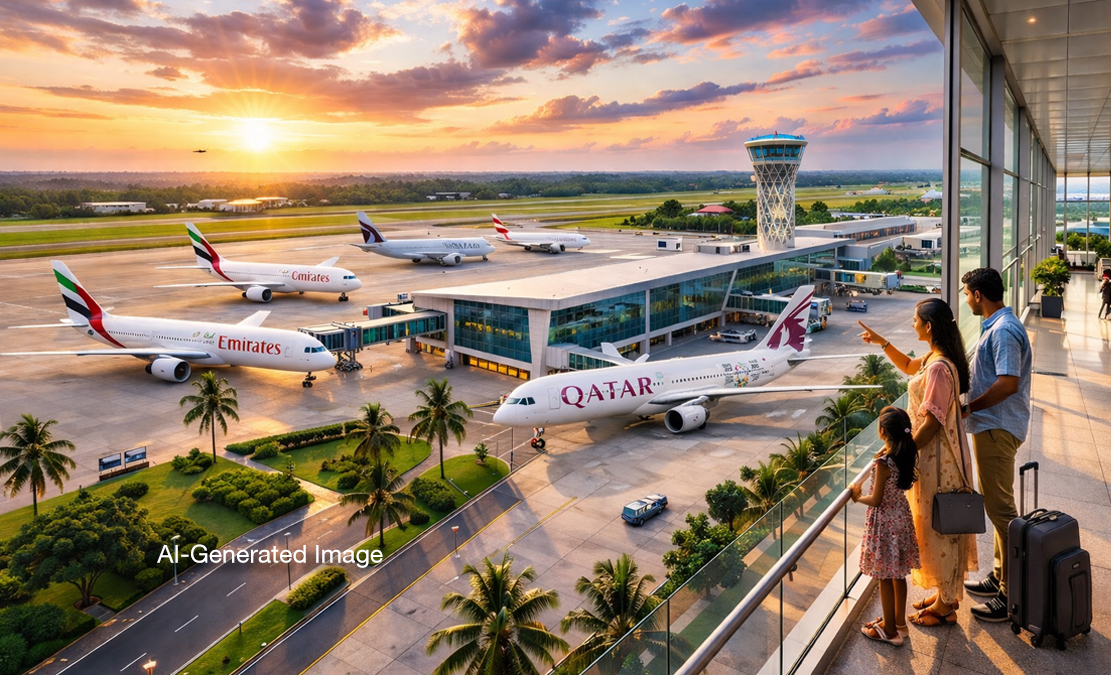
On 28 February, as tensions in the Middle East began to escalate, an important question emerged early: is Mattala Airport truly relevant during a Middle East crisis? At the time, with aircraft from airlines such as Emirates, Qatar Airways and Air Arabia temporarily positioned at Bandaranaike International Airport (BIA) before returning to their bases, it already felt as though Sri Lanka might be reacting slightly too late. Aviation Voice highlighted this issue on 4 March through a video
That conversation gained renewed momentum on March 19, when MP Ravi Karunanayake raised the matter in Parliament. He pointed out that Qatar Airways had already operated multiple repatriation flights from Sri Lanka to cities like London and Paris amid the disruption, and urged authorities to extend an open invitation to major Gulf carriers such as Qatar Airways and Emirates to utilize Mattala. Subsequently, Minister of Ports and Civil Aviation Anura Karunathilaka confirmed that discussions are currently underway.
To understand the real opportunity, it’s important to look at how global aviation functions.
The global air transport network is built around major hubs such as Dubai, Doha, London, Istanbul and Singapore, which handle massive volumes of passenger transfers every day. Under normal conditions, nearly 10,000 aircraft movements pass through Middle Eastern airspace daily. However, with the Iran-Israel conflict that began on February 28, key Gulf hubs including Dubai, Doha, Abu Dhabi, Bahrain and Kuwait have faced sudden operational disruptions due to airspace closures, safety concerns and rerouting challenges. What started as a regional issue has quickly evolved into a global aviation disruption.
So where does Mattala fit into this picture?
Mattala Rajapaksa International Airport (MRIA) is a Code F airport, capable of accommodating the world’s largest aircraft, including the Airbus A380. It has 10 parking bays, including two aerobridges and the capacity to handle up to one million passengers annually. However, despite having significant space for expansion, the absence of a parallel taxiway to the runway continues to limit operational efficiency.
That said, Mattala’s low congestion and its location away from conflict-affected zones offer clear operational advantages, particularly in times of crisis.
Even so, expecting airlines like Emirates or Qatar Airways to shift their hub operations to Mattala in the short term is unrealistic. These airlines operate highly complex, integrated hub systems centered in Dubai and Doha, with tightly coordinated passenger connections, cargo logistics and maintenance networks. Relocating even a fraction of that eco-system is not something that can happen quickly or easily.
In addition to that, the surrounding infrastructure remains a significant constraint. Airlines such as Qatar Airways and Emirates carry a large share of business travelers and Mattala currently lacks the commercial, hospitality and connectivity ecosystem that Colombo provides. Even reaching Colombo from Mattala takes around three hours, making it less attractive for premium passengers and time-sensitive travel.
Given these realities, a more practical short-term strategy would be to focus on labor and budget travel segments. This aligns better with the operating models of low-cost carriers such as flydubai, Jazeera Airways, which cater to a different passenger profile and have more flexible network strategies.
However, this does not mean Mattala lacks a role far from it
One of the most immediate and realistic opportunities lies in aircraft parking and fleet protection. During periods of instability, airlines often move aircraft to safe, low-traffic airports. For example, Bahrain previously relocated aircraft to Al-Ula International Airport in Medina, Saudi Arabia under similar conditions. With available parking capacity and minimal congestion, Mattala is well-positioned to support such temporary fleet relocation requirements.
Beyond that, there is also near-term potential for Mattala to serve as a technical stop, crew rest base, or even a limited cargo turnaround point, provided there is adequate infrastructure support, fast approvals and clear policy direction.
Importantly, MRIA has been operating under an open-skies policy, including 8th freedom traffic rights, to encourage international airlines. This gives Sri Lanka a regulatory advantage to facilitate such operations quickly, if executed efficiently.
For this potential to materialize, strong coordination is essential. The Civil Aviation Authority of Sri Lanka (CAASL), along with other relevant state institutions, must ensure fast-tracked approvals, operational readiness, and consistent policy support.
History offers useful lessons. During the 2006 Lebanon-Israel conflict, Cyprus (an Island) functioned effectively as a technical stop hub, while Shannon Airport in Ireland has long played a similar supporting role in global aviation. These airports did not replace major hubs but they became critical when the system needed alternatives.
Mattala may not be the primary solution to the current Middle East aviation crisis. But if positioned correctly, it can become a reliable support airport during disruptions and more importantly, a stepping stone toward a broader aviation ambition.
Because in aviation, many of today’s major hubs were not built overnight, they were shaped by moments of crisis, recognized and seized with the right vision.
Dev Kowsala Samarajeewa
Founder & CEO – Aviation Voice

