



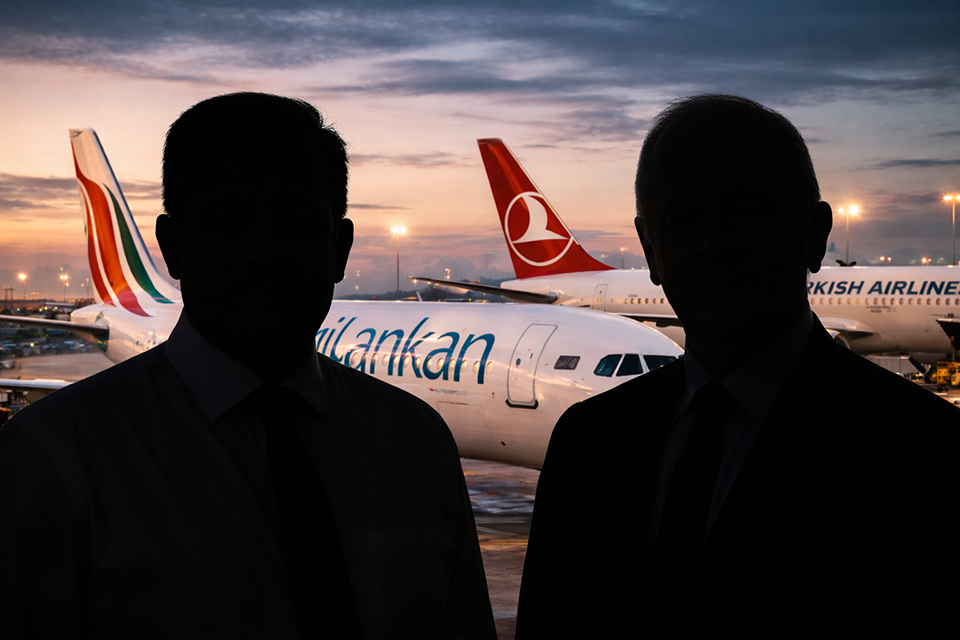
While Turkish Airlines moves decisively with a major leadership overhaul, Sri Lanka’s national carrier continues to face uncertainty at the top.
On April 9, Turkish Airlines, now operating a fleet of over 500 aircraft, announced one of the most significant management restructurings in its history. Industry veterans Ahmet Olmuştür (46), formerly Chief Commercial Officer (CCO), was appointed as Chief Executive Officer (CEO), while Murat Şeker (50) assumed the role of Chairman. The swift transition, led by young local leadership, highlights the airline’s proactive approach to governance and long-term strategy.
In contrast, SriLankan Airlines continues to grapple with a prolonged leadership gap. Former CEO Richard Nuttall stepped down in April 2025 and a full year later, the position remains vacant despite multiple interview rounds yielding no outcome.
The situation is further complicated by the resignation of Chairman Sarath Ganegoda on 31st March 2026. More than two weeks on, no successor has been officially appointed, raising concerns over delays in critical decision-making at a time when the airline is under financial pressure.
Recent financial reports indicate that SriLankan Airlines recorded a loss of Rs. 2.73 billion for the 2024/25 financial year, underscoring the urgent need for stable and effective leadership. Historically, the airline formerly AirLanka, reported profits during the early 1990s under Dunstan Jayawardene and later under Harry Jayewardene. Profitability was also achieved during the Emirates management period from 1998 to 2008, after which the airline has consistently struggled to remain in the black.
Sources indicate that several names have been considered for the chairmanship, including current Sri Lanka Tourism Chairman Buddhika Hewawasam and Peter Hill, the former CEO of SriLankan Airlines during the Emirates era. However, the President is reportedly inclined to retain Hewawasam in his current role amid ongoing challenges in the tourism sector.
Peter Hill remains a potential candidate, though factors such as internal political considerations, nationality and age are said to be influencing the decision-making process. Meanwhile, past remarks by the President on the age factor during his time in opposition have resurfaced on social media, drawing renewed public attention.
Reports that an appointment would be made today, April 17, now appear uncertain with sources indicating further delays.
As SriLankan Airlines approaches its 48th year of operations, the prolonged leadership vacuum has sparked renewed debate over governance, strategic direction and the need to cultivate and position capable young local talent for top roles particularly at a time when global competitors are moving decisively to strengthen their leadership structures.

